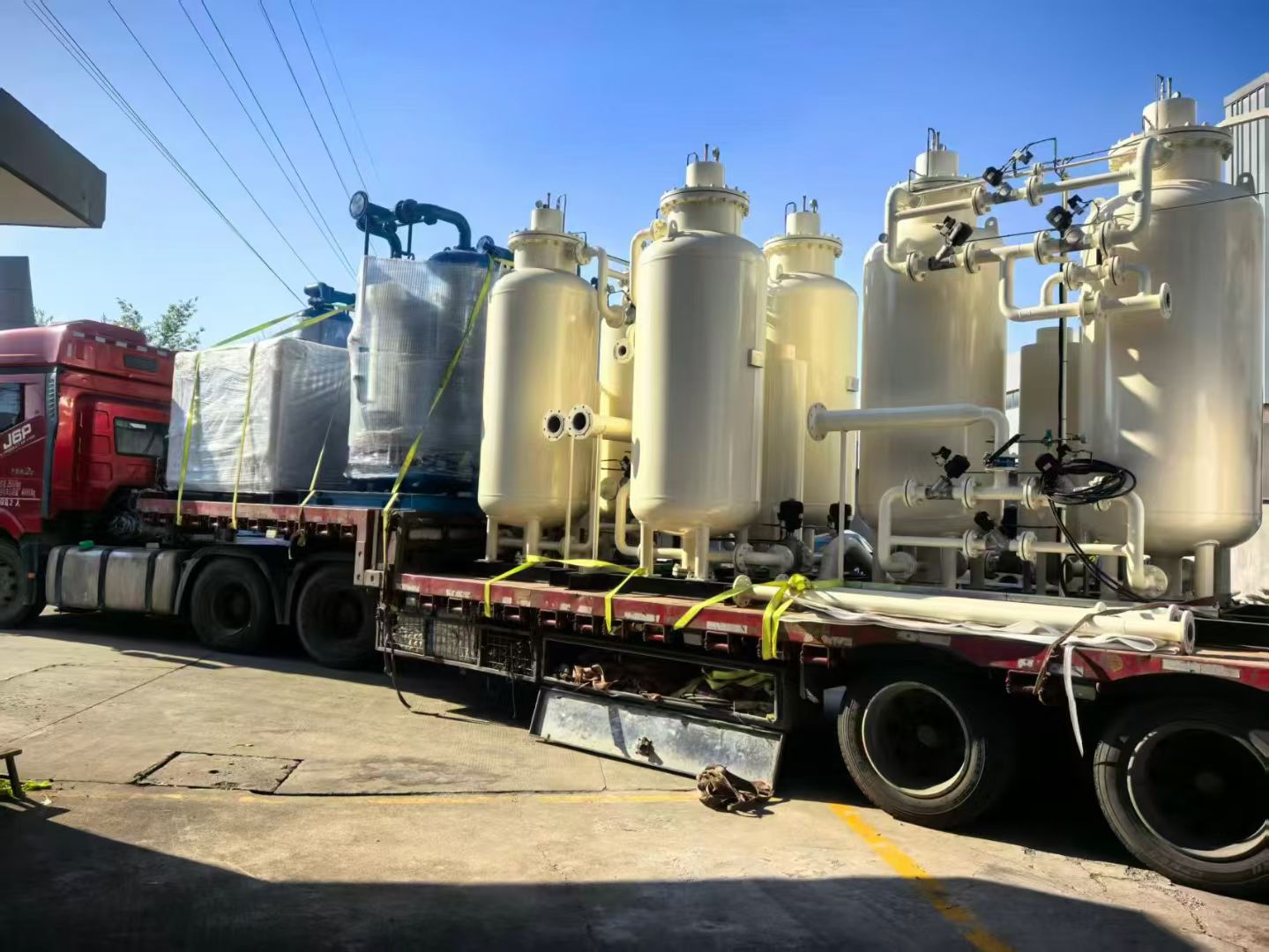
The cylinder compression device for nitrogen generators is one of the core components of pressure swing adsorption (PSA) nitrogen generators. It mainly functions on the molecular sieve bed layer inside the adsorption tower, ensuring the stability of the molecular sieve under alternating pressure conditions through a compression mechanism driven by a cylinder. This is a key device for the efficient and stable operation of nitrogen generators
I. Main Application Scenarios
The internal fixation of the adsorption tower of PSA nitrogen generators is its most core application scenario. The principle of PSA nitrogen generation is to separate nitrogen from air by utilizing the selective adsorption of molecular sieves for nitrogen and oxygen, through a cycle of pressurized adsorption and depressurized desorption. During the pressure alternation process, the molecular sieve particles may experience "fluidization", "displacement", or even breakage. The cylinder compression device is installed at the top (or bottom) of the adsorption tower and uses the stable pressure output by the cylinder to compress the molecular sieve bed layer, preventing excessive friction and displacement between the particles.
Adaptability to various nitrogen generation systems under different working conditions
It is suitable for various industrial nitrogen generation scenarios, such as in the chemical, electronic, food packaging, metallurgical, and pharmaceutical industries. Whether it is a small laboratory nitrogen generator or a large industrial nitrogen generation system, as long as the PSA process is adopted, most will be equipped with a cylinder compression device, especially in high-pressure and high-frequency start-stop nitrogen generation conditions, where its necessity is more prominent.
Assistance in molecular sieve replacement and maintenance
During the shutdown and maintenance of the nitrogen generator and the replacement of molecular sieves, the compression mechanism can be quickly released by controlling the extension and retraction of the cylinder, facilitating the filling and removal of the molecular sieves and reducing maintenance difficulty and time.
II. Core Features
Stable and adjustable pressure, strong adaptability
The compression force of the cylinder can be precisely adjusted through the pressure of the air source or a pressure regulating valve, matching the requirements of different types of molecular sieves, different adsorption tower volumes, and different nitrogen generation working conditions. For example, for molecular sieves with finer particles, the compression force can be appropriately reduced to avoid particle breakage; for high-pressure adsorption conditions, the compression force can be increased to ensure the stability of the bed layer.
Fast response, suitable for PSA cycles
The adsorption-desorption cycle of PSA nitrogen generation is usually within a few minutes. The cylinder compression device uses pneumatic drive, with a fast response speed, maintaining a stable compression state during pressure alternation, avoiding the displacement of molecular sieves due to sudden pressure changes, and ensuring the stability of nitrogen generation efficiency and purity.
Simple structure, high reliability, and low maintenance cost
Compared with hydraulic compression and mechanical compression methods, the cylinder compression device has a simpler structure, mainly composed of a cylinder, a piston rod, a compression plate, and an air source pipeline. There are fewer moving parts and fewer failure points. Daily maintenance only requires regular checks on the air source pressure and the condition of the sealing parts, resulting in lower maintenance costs.
Smooth operation, no risk of secondary pollution
The pneumatic drive method operates smoothly and does not cause impact on the interior of the adsorption tower. Moreover, as long as the air source is dried and purified, it will not cause secondary pollution to the molecular sieves or nitrogen, meeting the clean nitrogen generation requirements of industries such as food and pharmaceuticals.
Overload protection feature
Most cylinder compression devices are equipped with overload protection functions. When the resistance of the molecular sieve bed layer becomes too large due to thermal expansion and contraction or abnormal conditions, the cylinder can relieve pressure through its own buffer structure or pressure regulating valve, preventing damage to the compression mechanism or the adsorption tower shell.